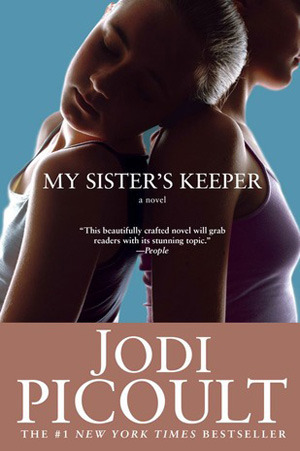
My Sister’s Keeper by Jodi Picoult
Narrated by: Richard Poe, Julia Gibson, Barbara McCullough and others
Published: March 29, 2016 by Simon & Schuster Audio
Buy this book at: Amazon / Barnes & Noble / Kobo
Synopsis:
Anna is not sick, but she might as well be. By age thirteen, she has undergone countless surgeries, transfusions, and shots so that her older sister, Kate, can somehow fight the leukemia that has plagued her since childhood. The product of preimplantation genetic diagnosis, Anna was conceived as a bone marrow match for Kate — a life and a role that she has never challenged… until now. Like most teenagers, Anna is beginning to question who she truly is. But unlike most teenagers, she has always been defined in terms of her sister—and so Anna makes a decision that for most would be unthinkable, a decision that will tear her family apart and have perhaps fatal consequences for the sister she loves.
A provocative novel that raises some important ethical issues, My Sister’s Keeper is the story of one family’s struggle for survival at all human costs and a stunning parable for all time.
Rating: 
Review: Spoiler alert: This book irritated me, so I doubt that I will be able to discuss it without spoilers. Consider this your warning.
From the audiobook side, this was very well done. The narrators were very good. I always enjoy having a full voice cast on an audiobook. It makes the audiobook much more of a performance, which I find a wonderful experience. I am very pleased that a lot of audiobooks are moving in the direction of a full voice cast and I hope that’s a continuing trend.
I gave this book two stars mainly because of the moral issues and dilemmas that it discusses. I found the concept of the book fascinating. What would any of us do in the face of our child’s inevitable death? To what lengths would we go to save them? In this book, the parents decide to conceive a child through in-vitro fertilization. But they implant an embryo that is genetically match to their sick child. They have the best of intentions, they are only going to give their sick daughter an umbilical cord blood transfusion, which the new baby doesn’t need anyway. And it works for awhile. Kate goes into remission. But, then she doesn’t. And all of a sudden, it starts becoming reasonable to have your young daughter donate other things. Blood, plasma, bone marrow. The story kicks off when Anna is expected to donate a kidney to her sister, and she doesn’t want to. So she goes to a lawyer and asks if she can sue her parents for the right to make this decision on her own. As she points out, as a child, no one ever bothered to ask what she wanted.
This book had so much wonderful potential! The very issues of bodily autonomy, parental decision making, bodily consent are highlighted on every page. The problem is that the only sympathetic people in this book are Anna and Kate. Their parents are awful, horrendous people. I thought they would be sympathetic people who felt desperate to do the right thing. Instead I found horrendous abusers who berate their healthy children because they have the audacity to be healthy. For example, when Anna isn’t allowed to play hockey because practice would interfere with her ability to donate plasma to her sister. When Anna wants to go to a summer camp, she is berated for even asking. At one point her mother screams at her “Your organs need to be here for Kate, not off at camp!” Wow. Just wow. You’ve entirely reduced your child’s existence down to being body parts that need to be available to someone else. I wanted to vomit. These people were awful.
The ending of the book was similarly terrible. It felt like the author lost her nerve. She didn’t want to make a hard decision so she just opted out of making any decision at all. At the end of the book, Anna confesses that she actually wanted to donate her kidney to Kate. But Kate asked her to refuse, because Kate is ready to die. Kate doesn’t want to keep living like this. That part was ok. It made the book less compelling than Anna wanting to fight for her autonomy, but I was willing to go with it.
Then, it all goes to hell. Anna wins her case. She is awarded autonomy to make her medical decisions, and her attorney is appointed as her POA to sign all the paperwork for her and do the official things that she is too young to do. Anna decides that she is going to donate her kidney after all, if Kate will accept it. And on the way to the hospital to see Kate, Anna is killed in a car accident. And the book happily recounts how Anna ended up donating her kidney to Kate in the end after all. What a letdown. While I had no sympathy for the parents, I had a lot of sympathy for Anna and Kate. They were both in an impossible situation and I wanted to see how it ended. But it didn’t end. Anna wins a pointless victory, and ends up being a kidney donor anyway…..well, that happened.
 Written Among The Stars