
Nuclear War by Annie Jacobsen
Published: March 26, 2024 by Dutton
Buy this book at: Amazon / Barnes & Noble / Kobo
Synopsis:
There is only one scenario other than an asteroid strike that could end the world as we know it in a matter of hours: nuclear war. And one of the triggers for that war would be a nuclear missile inbound toward the United States.
Every generation, a journalist has looked deep into the heart of the nuclear military establishment: the technologies, the safeguards, the plans, and the risks. These investigations are vital to how we understand the world we really live in—where one nuclear missile will beget one in return, and where the choreography of the world’s end requires massive decisions made on seconds’ notice with information that is only as good as the intelligence we have.
Pulitzer Prize finalist Annie Jacobsen’s Nuclear War: A Scenario explores this ticking-clock scenario, based on dozens of exclusive new interviews with military and civilian experts who have built the weapons, have been privy to the response plans, and have been responsible for those decisions should they have needed to be made. Nuclear War: A Scenario examines the handful of minutes after a nuclear missile launch. It is essential reading, and unlike any other book in its depth and urgency.
Rating: 
Review:
After listening to an interview with Annie Jacobsen I knew that I needed to read this book. And apparently a lot of other people thought the same thing, because this one had a 6 month waitlist from my library. Even for the audiobook, which is insane because the audiobook normally has a shorter wait time. But I digress. I have long had feelings about nuclear weapons and the idea of deterrence and mutually assured destruction. That has been the stance of world on nuclear weapons. “Well, we both have them, and we know that if one of uses them then so will the other, and no one wants that.”
There’s just one problem with that theory, human nature. Eventually there will be a human who says, “Fuck the consequences, if I’m going down then so are they.” Human nature virtually guarantees this. And this is what Annie Jacobsen explores. She explores in depth the timeline of a nuclear war. Starting at the beginning when there is a satellite confirmation that a missile has been fired. She goes through the exact conversations that would be happening. Was it an accident? Is it just a missile or does it have a nuke on it? Where is it headed? Could this be a misfire? What exactly is going on and how do we respond? The timeline for making this decision is very short. In the best circumstance that timeline is about 6 minutes. Six minutes to try and figure out what happened and if the US will respond. And that is the best case scenario, if a missile was launched from a submarine then the timeframe could be a minute total.
The author also goes through the timeline of just how many times the United States has been on the brink of nuclear war and luckily it hasn’t happened. Did you that in 1983 the Soviet Union’s radar detection system alerted that the United States had launched give nuclear missiles at the Soviet Union. Stanislav Petrov was manning the radar. His procedures required that he report the radar results to Moscow. But he didn’t, because he thought it was strange. Later, he said that he asked himself “Why would the United States only launch 5 missiles? If they wanted a nuclear war, they would fire many more, wouldn’t they?” And he chose to believe it was a false alert. It was indeed a false alert. But think about what could have happened if he had followed procedure?
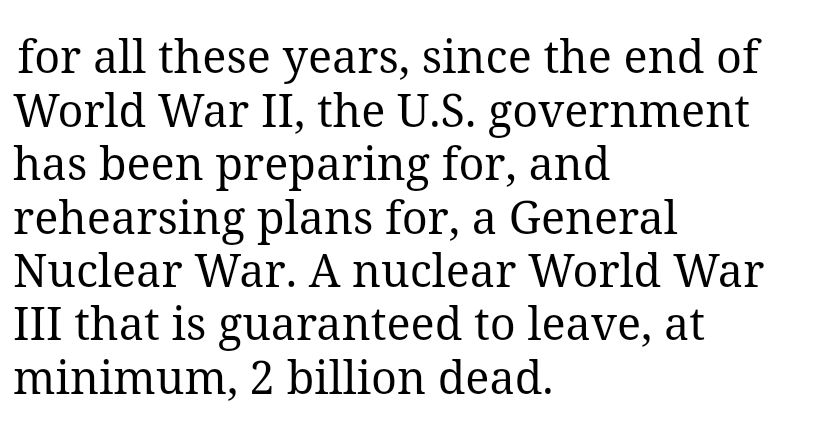
I spent a lot of time wondering what kind of scenario Annie Jacobsen had created in this book. Was this a best case scenario? Average scenario? Worst case scenario? But then I realized something. She talked about how the Defense Department runs war game simulations on how a nuclear war would proceed. Hundreds of them. Potentially thousands of them. They’ve been running them since the first nuclear bomb was invented. And according to the source Jacobsen spoke to, every single scenario they have run ends in global annihilation. That’s when I realized, it doesn’t matter what kind of scenario it is. They all end the same way. They all end with human beings annihilating themselves. The only solution is for no one to press the button, ever. But even that doesn’t account for accidents. For as long as nuclear weapons exist, this book posits that eventually, for one reason or another, nuclear war is how it ends.
My only complaint is that some of the imagined dialogue is very corny. And I found some of the posited hypothetical events to unnecessary to the situation and it doesn’t add much value.
So, this book was possibly the most frightening thing I’ve ever read. Also one of the most important. I am going to get myself a stiff drink and hope that if nuclear war happens, I’ll be close enough to the blast to be evaporated.
As Nikita Khrushchev said to JFK, in the event of nuclear war “The survivors would envy the dead.” That’s a grim thought, but one that we all need to pay attention to. Do you trust the people guarding that button? I don’t. Not a single one of them.




 Written Among The Stars