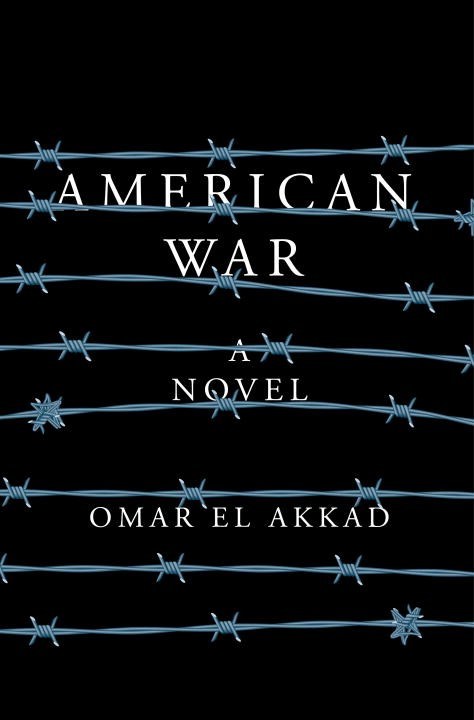
American War by Omar El Akkad
Published: April 4, 2017 by Knopf
Buy this book at: Amazon / Barnes & Noble / Kobo
Synopsis:
An audacious and powerful debut novel: a second American Civil War, a devastating plague, and one family caught deep in the middle a story that asks what might happen if America were to turn its most devastating policies and deadly weapons upon itself
Sarat Chestnut, born in Louisiana, is only six when the Second American Civil War breaks out in 2074. But even she knows that oil is outlawed, that Louisiana is half underwater, and that unmanned drones fill the sky. When her father is killed and her family is forced into Camp Patience for displaced persons, she begins to grow up shaped by her particular time and place. But not everyone at Camp Patience is who they claim to be. Eventually Sarat is befriended by a mysterious functionary, under whose influence she is turned into a deadly instrument of war. The decisions that she makes will have tremendous consequences not just for Sarat but for her family and her country, rippling through generations of strangers and kin alike.
Rating: 
Review:
I believe that there are two ways to write a really great dystopian novel. First, you set the book so far into the future that it doesn’t really matter how outlandish the world building or the situation are. Readers will look at it and think “Well, it’s 400 years in the future, I guess that could happen.” Second, you base it in a more recent reality, but change a few key situations or circumstances that logically explain how the world got to this state in the near future.
Unfortunately, this book doesn’t convincingly do either one. The premise of this book is that in 2074 the United States has a second Civil War. Ostensibly, the war is over oil. Oil has been outlawed due to climate change and some states decide that they want to continue using it and so they engage in a Civil War. After the war ends (about 20 years), there was a devastating plague that swept the nation and things have been in a state of crisis ever since. This book is set somewhere in the midst of the war when the main character and her family flee to a refuge camp to escape the war and the plague. I really wanted a better explanation for how the United States gets to a Civil War just 50 years from now. I simply didn’t understand how the conflicts about climate change and oil reach that boiling point so soon.
WARNING: From here on out there will probably be spoilers. But I find this book to be crap that I would recommend to no one, so feel free to continue at your leisure.
So, ostensibly this war is about oil. Except that doesn’t make any sense. Apparently climate change has gotten so bad that most of the American Southwest is just perpetually on fire and unlivable, and half of Louisiana is permanently underwater, and the ice caps no longer exist. I find it hard to believe that in the face of such catastrophic changes to the world that there would be so much climate change skepticism left to start a war over. Currently there’s a lot of nuance to climate change opinions. People who believe that it is entirely man made and we have to do something about it. People who believe it is a natural cycle of the earth that we have little to no influence over. People who believe it’s all made up and not actually happening. People who believe that it is happening, humans are responsible, but we’ll find ways to innovate solutions as times goes on. But despite this diversity of opinions, in 50 years time everyone either boils down into “let’s ban oil to help climate change” or “we want oil, because….we want it.” I find that difficult to imagine. I also find it hard to believe that there would be enough people who feel strongly enough about oil to start a war over it. Apparently there’s three states that started the war, and a few others joined along the way. Texas was part of it at one point, but it’s now part of Mexico for some reason. So they are kind of affiliated, but not really. It’s confusing. Let’s also ignore that even the most catastrophic climate change predictions state that the temperature difference will be about 1 degree in 100 years….
Really, what this author does it just replace slavery with oil and utilize all the same tropes and circumstances of the first civil war and overlaid it into the book. But instead of the Union we have “the blues”, instead of the Confederacy we have “the reds”. It was not well done. The author tells us the war is about oil but it isn’t. It’s about typical Old South tropes of racism, misogyny, and classism. It also doesn’t seem like this is even a world that can survive without oil in the first place. For example, “the blues” have warships that are supposed to enforce the oil ban, they have solar panels. But the solar panels are so inefficient that the ships regularly use their diesel engines to get things done….the author tells us this as an aside, like it’s a normal course of business. That was so weird. You ban oil but still haven’t advanced alternative energy sources enough to actually be useable? What?
Speaking of oil, apparently in this book the “Middle East” and “North Africa” decided to put aside thousands of years of conflict and culture differences to form a new world superpower. Where apparently everything is sunshine and rainbows. And things are so good that everyone in Europe is fleeing to this new land on boats as refugees. No explanation is given for how this happens, nor why. Just that it happened. Some of these countries have been having continued conflicts over religion, race, class, culture, etc for literally thousands of years. But, everything is cool now? In 50 years? That doesn’t seem likely either.
It also isn’t difficult to figure out that the author has overlaid current political differences (and his own political opinions) onto this book. “The reds” are bad people. They like guns, and oil, and hate women and gay people. “The blues” believe in trying to help the world, and love everyone, and want to save the planet. Huh, that sounds very 2016 to me. It’s egotistical and ridiculous. To think that the political stage wouldn’t have advanced past the tropes and stereotypes that the two sides throw at each other in current times is laughable.
There were a lot of other things that were laughable and ridiculous about this book but I just can’t devote more time to it. I only got halfway through and that was already a waste of my time. The next “great American novel” this is not.
 Written Among The Stars