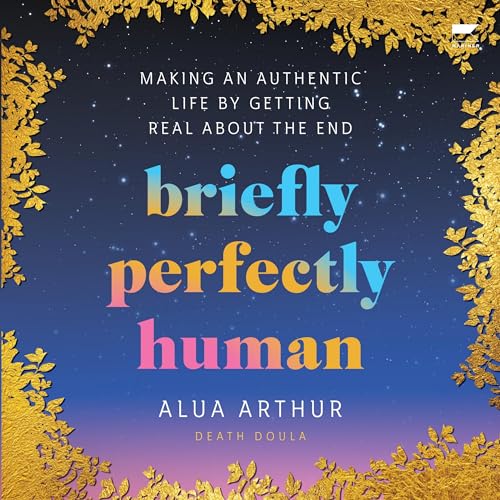
Synopsis:
For her clients and everyone who has been inspired by her humanity, Alua Arthur is a friend at the end of the world. As our country’s leading death doula, she’s spreading a transformative message: thinking about your death—whether imminent or not—will breathe wild, new potential into your life.
Warm, generous, and funny AF, Alua supports and helps manage end-of-life care on many levels. The business matters, medical directives, memorial planning; but also honoring the quiet moments, when monitors are beeping and loved ones have stepped out to get some air—or maybe not shown up at all—and her clients become deeply contemplative and want to talk. Aching, unfinished business often emerges. Alua has been present for thousands of these sacred moments—when regrets, fears, secret joys, hidden affairs, and dim realities are finally said aloud. When this happens, Alua focuses her attention at the pulsing center of her clients’ anguish and creates space for them, and sometimes their loved ones, to find peace.
This has had a profound effect on Alua, who was already no stranger to death’s periphery. Her family fled a murderous coup d’état in Ghana in the 1980s. She has suffered major, debilitating depressions. And her dear friend and brother-in-law died of lymphoma. Advocating for him in his final months is what led Alua to her life’s calling. She knows firsthand the power of bearing witness and telling the truth about life’s painful complexities, because they do not disappear when you look the other way. They wait for you.
Briefly Perfectly Human is a life-changing, soul-gathering debut, by a writer whose empathy, tenderness, and wisdom shimmers on the page. Alua Arthur combines intimate storytelling with a passionate appeal for loving, courageous end-of-life care—what she calls “death embrace.” Hers is a powerful testament to getting in touch with something deeper in our lives, by embracing the fact of our own mortality. “Hold that truth in your mind,” Alua says, “and wondrous things will begin to grow around it.”
Rating: 
Review: **Spoiler alert** Since this is a memoir style book, I cant give an adequate review without talking intricately about the plot. Therefore, the review will likely spoil portions of the book.
This book is one of those times that I feel like the synopsis sold me a completely different book than the book I received. What I expected was a memoir that had a heavy focus on what she had learned in her work with the dying and lessons that she had hoped to pass on. But that isn’t the book I read. Alua’s work as a death doula isn’t really covered until the very end of the book and almost none of it was in any sufficient detail to take away a lesson from it. Most of the stories were about how the client’s situation impacted her. Which, as a doula, is not supposed to be the focus. Hopefully this is just because it is her perspective of the story and she comes across to her clients as centered on them and their needs.
I’m also not sure it was the right decision for the author to narrate the book herself. Audiobook narration is a specific skillset and not everyone has it, not everyone is able to convey the story accurately and truthfully while also making it compelling for the listener. That is where this one failed. This work is supposed to be Alua’s passion. Her life mission. But I heard none of that passion in her narration. Her tone was quite monotone and slow, which made it easy for me to tune out and stop paying attention because it didn’t compel my attention.
A large portion of this book is also devoted to Alua’s experience as a black Ghanaian woman. Naturally this made race and racism a big theme in the book. But in some of the circumstances it was difficult to have sympathy for her. For example, when she arrives at a client’s home and is told by the client’s sons that “Sorry, we should have told you that our dad is a little racist”. Now, there is no excuse for the sons actions. They knew damn well that Alua was a black woman. They knew full well that their dad was a racist. So it was entirely abhorrent that they tried to hire her at all. If she had rejected the job and gone back home every single person reading would have cheered. But she decided to stay. Only to help the sons, not interact with their dad. They agreed. And then they pushed her to help their dad. Again, abhorrent behavior on their part. Every single person reading would have supported her in walking away immediately and going home. No one should subject themselves to racism and hatred directed at them. Never for a moment.
But again, she decides to stay and interact with the father and participate in his care. A decision that I thought displayed a level of empathy and compassion that I could never understand. Then, as she is sitting at this dying man’s bedside she is privately thinking about how she wishes that he is suffering, wishes that they wouldn’t give him pain medication so that he would die miserable. Relishing the idea that he would die with his last image being a black woman. My eyebrows raised almost off my head. Clearly she was unable to provide the client compassionate or empathetic care. She could not remain neutral. And I don’t blame her, I doubt anyone could. And they shouldn’t have to, let me be clear. But she had numerous opportunities to remove herself from the abhorrent situation and decline to work with them. She chose not to and then told us the story of wishing this dying man would be in more pain. That is gross. If she couldn’t give the family the same service she gives others then she shouldn’t have been there. Then she sums it up with it being “another situation where I diminished myself as a black woman for the comfort of white folks.” I feel like that was the wrong lesson. The real lesson should have been that she needed to advocate for herself as hard and passionately as she advocates for her clients.
Often time the stories that the author tells focus on her efforts to help the dying client “die with grace”. While this is a nice ideal, it often isn’t a reality. And it seems like an unreasonable burden to put on a dying person, to have grace. It feels like the expectation is performative. Die with grace so that all of your family can have a nice experience. I didn’t like it. It made me feel uncomfortable.
Overall, I don’t think this book was for me. I was expecting something completely different and I didn’t enjoy what I got.
 Written Among The Stars