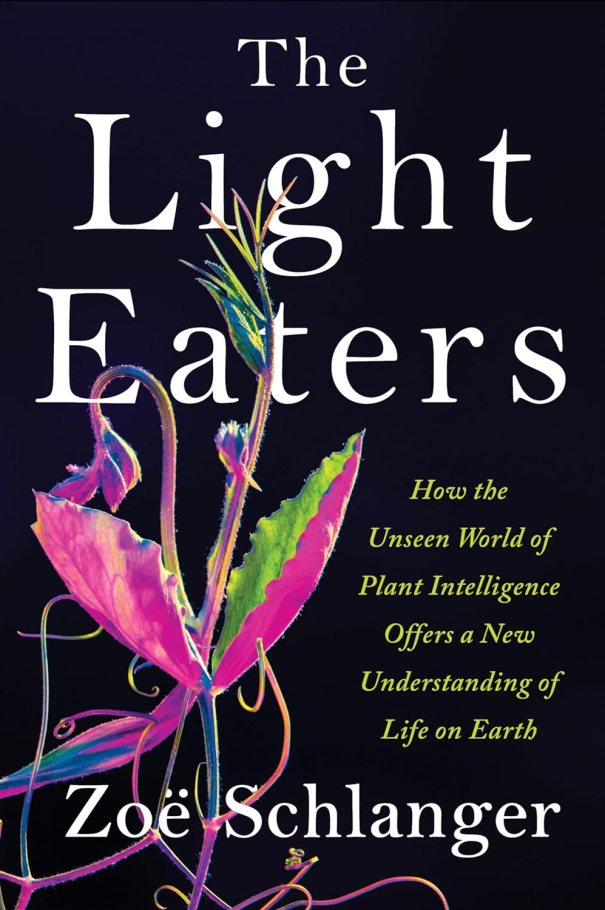
The Light Eaters by Zoe Schlanger
Published: May 7, 2024 by Harper
Buy this book at: Amazon / Barnes & Noble / Kobo
Synopsis:
Award-winning environment and science reporter Zoë Schlanger delivers a groundbreaking work of popular science that probes the hidden world of the plant kingdom and reveals the astonishing capabilities of the green life all around us. It takes tremendous biological creativity to be a plant. To survive and thrive while rooted in a single spot, plants have adapted ingenious methods of survival. In recent years, scientists have learned about their ability to communicate, recognize their kin and behave socially, hear sounds, morph their bodies to blend into their surroundings, store useful memories that inform their life cycle, and trick animals into behaving to their benefit, to name just a few remarkable talents.
The Light Eaters is a deep immersion into the drama of green life and the complexity of this wild and awe-inspiring world that challenges our very understanding of agency, consciousness, and intelligence. In looking closely, we see that plants, rather than imitate human intelligence, have perhaps formed a parallel system. What is intelligent life if not a vine that grows leaves to blend into the shrub on which it climbs, a flower that shapes its bloom to fit exactly the beak of its pollinator, a pea seedling that can hear water flowing and make its way toward it? Zoë Schlanger takes us across the globe, digging into her own memories and into the soil with the scientists who have spent their waking days studying these amazing entities up close.
What can we learn about life on Earth from the living things that thrive, adapt, consume, and accommodate simultaneously? More important, what do we owe these life forms once we come to understand their rich and varied abilities? Examining the latest epiphanies in botanical research, Schlanger spotlights the intellectual struggles among the researchers conceiving a wholly new view of their subject, offering a glimpse of a field in turmoil as plant scientists debate the tenets of ongoing discoveries and how they influence our understanding of what a plant is.
We need plants to survive. But what do they need us for—if at all? An eye-opening and informative look at the ecosystem we live in, this book challenges us to rethink the role of plants—and our own place—in the natural world.
Rating: 
Review:
I simply cannot say enough good things about this book. It was thought provoking, compelling, evocative, and also easily digestible. The book centers on the author who has spent her career reporting on environmental science and climate change. She was depressed about it. It was causing her to feel an existential dread and pessimism abut the world. So, she started reading botany publications. And she uncovered that the world of botany is booming with amazing discoveries. The botany world is exploding with all the new things that they are learning about plants, and also coping with how (if at all) it should change our overall worldview. This book comes from that starting point.
When I went into this book I didn’t know quite what to expect. A few years ago I read a book about fungi and was astounded at how complex fungi are and how little I knew about them. I feel a similar way after this book about plants. We all know the basics of how plants came into existence. Millions of years ago when the world still existed as basic multicellular organisms floating in a vast ocean, the atmosphere was a toxic blend of chemical that would not support any kind of life. In that environment the first plants found themselves on shore and did the most amazing thing. They inhaled all of the toxic chemicals in the air and excreted oxygen. As more plants emerged from the ocean this slowly started making the air more breathable. By the time the first animal creature crawled out of the ocean, the plants had already been evolving, living, adapting, and reproducing for 125 million years. They were now so vastly different than anything that would evolve later. And animals were perfectly suited to breath the oxygen being excreted by plants and exhaled it as carbon dioxide…which plants could consume and the cycle of life would advance.
This author tried very hard to not use human terminology when referencing what plants could do, but at a certain point…..what’s the use in trying? Words have meaning. We use words to identify things in our environment. So while scientists bristle at using words like “intelligence” or “behavior” with regard to plants, how else do you describe the behaviors that they witness? The book covers in detail the amazing things we’ve learned about plants, and also details the scientific resistance along the way. As Zoe Schlanger says:
“But science’s biggest flaw and biggest virtue is that it almost always mistakes agreement for truth.”
Scientists agree that plants aren’t intelligent and can’t communicate, so that must be the truth. But what else do you call it? When you discover that plants communicate with other plants in the vicinity that a pest has arrived, and the other plants respond by turning on their pest defense systems. What else could that be called if not communication? When plants are growing next to genetically related plants they will grow in ways that share resources equally but when growing next to unrelated plants will compete for the resources. What else could you call that except intelligence?
I have a million things to say about this book and I couldn’t recommend it more. In the end, I came away with this realization: Intelligence and sentience are an inherent part of existing. Every single individual cell that makes up the world shows the ability to recognize itself and other, shows the ability to avoid things that injure them, shows the ability to seek out resources to preserve themselves. I am starting to believe that the entire world is sentient. The entire world is intelligent. All of us, down to a single cell, are connected in ways that have been evolving for hundreds of millions of years. None of us can survive without the others. It is just a fact that humans are very bad at recognizing any kind of intelligence that doesn’t mirror our own. But just because it doesn’t look like something we recognize doesn’t mean it’s not intelligence.
 Written Among The Stars